

A Normal Life
She wanted a life no one could punish. Something beneath them listened.

The first time Elena said she wanted a normal life, I thought she meant a safer one.
That was how women like us spoke back then. We learned to place softer words over sharp things.
Normal meant not looking over your shoulder when you left a bar. Normal meant not pretending the woman beside you was your cousin when the landlord came by. Normal meant not laughing too loudly in restaurants. Not brushing fingers beneath a tablecloth. Not writing letters that could ruin you if someone opened the wrong drawer.
Normal meant being able to walk down the street with the person you loved and not feel the whole world sharpening itself around you.
So when Elena said it, I understood… or I thought I did.
She was standing at the sink in our kitchen at Saint Germaine, sleeves rolled to her elbows, her dark hair pinned badly at the back of her neck. A strand had come loose and curled against her cheek. There was dish soap up to her wrists and one of my cigarettes burning untouched in the ashtray by the window.
“I’m tired, Lydia,” she said.
I was folding laundry at the table. Stockings. Hand towels. The white blouse she wore to the department store because the manager said it made her look “pleasant.”
“Tired of what?”
She laughed once. Not because anything was funny.
“You know what.”
I did. Of course I did.
I knew the coded knocks on certain apartment doors. I knew which diners kept serving coffee past midnight without asking why two women sat too close. I knew the side streets near the bars where police wagons idled with their headlights off. I knew how quickly a room full of laughter could turn into women grabbing purses and men slipping out back doors. I knew how to put my hand down before anyone saw me touching hers.
I knew how to become no one in public.
Elena turned from the sink and leaned against it, water dripping from her fingers onto the worn tile floor.
“Don’t you ever want to stop hiding?”
I looked at her for a long moment.
“Yes,” I said. “But not like that.”
She looked away.
I should have asked what she meant. Instead, I kept folding. That was the kind of mistake you only recognize after the world has rearranged itself around it.
Saint Germaine had only been apartments for four years then. Before that, it had been a hospital. You could still feel it in the walls.
No matter how much paint the owners spread over the old plaster, the place kept its first purpose. The corridors were too wide. The doors too heavy. The elevator still had padded walls from when they moved beds between floors. Some of the apartment numbers had been screwed over faint rectangular shadows where hospital signs used to hang.
The building smelled different in summer. Not bad. Just old. Antiseptic under dust. Hot metal. Damp cotton. Something medicinal that rose through the floors when the radiators slept.
Our apartment had been part of a respiratory ward once. The superintendent told us that as if it were a selling point.
“Good bones,” he said, tapping the doorframe. “Thick walls.”
People liked saying that about places where many people had suffered.
Good bones.
As if bones were good because they stayed behind.
Elena hated the building at first. She said the rooms were too still. She said the hallway lights buzzed like flies. She said the floor felt warm even when the windows were open. But the rent was cheap and no one asked questions if two women signed a lease together. The superintendent barely looked up from his cigarette when we told him we were cousins.
“Everyone’s cousins here,” he said.
So we stayed.
That first winter, before anything changed, Elena and I slept pressed close because the bedroom window leaked cold air around the frame. She always put her feet against my legs and apologized while doing it.
“Your feet are crimes,” I told her.
“They’re evidence,” she said.
“Of what?”
“That I’m still here with you.”
Then she would laugh into my shoulder, and for a few hours, the room would feel like something we had won. Not legally. Not safely. But completely.
Those were the hours I remember best now. Not because they were happy, though they were. Because happiness like that had to be smuggled.
Hidden happiness has a texture. It is sharper than other happiness. More awake.
You know exactly how much it costs.
The trouble started with Frances.
Everyone knew Frances, though no one admitted it loudly. She worked mornings at a bakery and nights wherever there was music. She wore trousers better than any man I had ever seen and kept her hair short enough to make strangers stare. She called every woman “darling” with the same careless confidence men mistook for permission.
One Friday, she did not come home.
By Saturday morning, everyone knew there had been a raid.
Not officially. Officially, a group of “undesirables” had been detained after a disturbance at a tavern south of the park. That was the newspaper word.
Undesirables.
It was strange how clean cruelty looked in print. No blood. No crying. No names. Just a word that could swallow whole lives and still leave room for an advertisement about floor wax beside it.
Frances returned three weeks later.
She came to Saint Germaine to collect a coat she had left with a friend on the fourth floor. Elena and I saw her in the lobby.
Or what was left of her.
Her hair had been set in soft waves. She wore a skirt suit the color of oatmeal and white gloves buttoned at the wrist. There was a small cross at her throat. Her mouth held a polite smile I had never seen on her before.
“Elena,” she said warmly. “Lydia.”
Not darling. Never darling again.
Elena stepped forward first.
“Frances?”
The woman smiled.
“Yes.”
Just yes. As if nothing strange had happened. As if she had not once danced on a table at Murphy’s with a cigarette between her teeth and half the room shouting her name. As if she had not kissed a woman in an alley and laughed afterward because surviving made her reckless.
“How are you?” Elena asked.
“Better,” Frances said.
That word moved through the lobby like cold water.
Better.
She glanced toward the front doors, where a man waited on the sidewalk with his hat in both hands. He was handsome in a washed-out way. Gray suit. Clean shave. A pleasant face with nothing alive behind it.
“My fiancé is waiting,” Frances said.
Elena went very still.
“Your what?”
“My fiancé.” Frances smiled wider. “We’re getting married in June.”
I watched her hands when she said it. They did not tremble. That frightened me more than if they had.
Later, in our apartment, Elena sat at the kitchen table for almost an hour without taking off her coat.
“She looked peaceful,” she said.
“She looked gone.”
“You don’t know that.”
“I know Frances.”
Elena looked at me then, and there was something raw in her face.
“Maybe she got tired.”
I hated that I understood. We were all tired.
That was the part no one outside the closet ever understood. They thought hiding was simply secrecy. A door closed. A mouth shut. A hand withdrawn.
They did not understand that hiding was labor.
Constant. Physical. Exhausting labor. A second body you carried everywhere.
Elena rubbed at the bridge of her nose.
“Maybe peace is what it looks like after you stop fighting.”
I said, “That wasn’t peace.”
She whispered, “Then what if I want it anyway?”
The floor shifted beneath us. Not much. Just enough that the kitchen chair gave a small, tired creak.
Elena did not seem to notice.
I did.
That was the first time I felt the building breathe. Not as a sound. As pressure. A slow rise beneath my feet. Then a settling.
Up.
Down.
Like something old beneath the floor had drawn one careful breath and let it out again.
“Elena,” I said.
She was looking past me toward the bedroom door. It stood slightly open. I was sure I had closed it.
After Frances, Elena changed in small ways. That is how it happens first. Small things. Easy things.
Things you can explain if you love someone enough.
She started sleeping through the night. That should have been good. Before, Elena’s sleep had always been restless. She twisted blankets around her legs. Kicked one foot free. Woke from dreams she would not describe. Sometimes I would find her sitting at the edge of the bed, one hand pressed to her chest, listening for something she insisted was not there.
But now she slept cleanly. Perfectly. On her back, hands folded over her stomach like a woman in a photograph. Her breathing became even.
Too even.
I would wake beside her and wait for the small human irregularities. A catch. A sigh. A shift. Nothing.
Just inhale.
Exhale.
Inhale.
Exhale.
A rhythm so steady it made my own body feel badly made.
She started dressing differently too. At first it was just effort. Lipstick before work. Gloves without holes. Hair pinned neatly enough that no strand escaped by lunch.
Then skirts.
Then pearls.
Then a pale blue dress with a fitted waist and white collar.
I found her standing in front of the mirror in it one morning. I was still in my slip, cigarette unlit between my fingers.
She looked beautiful.
That was the unfair part. She looked more beautiful than ever. Calm had settled over her face like good lighting. Her skin seemed clearer. Her posture straighter. Her eyes less troubled.
“You hate blue,” I said.
She smoothed the front of the dress.
“It suits me.”
“It suits somebody.”
She looked at me in the mirror. The reflection smiled a fraction before she did. Not enough to be certain. Just enough to make my hand tighten around the cigarette.
“You should wear the green one tonight,” she said.
“What?”
“The green dress. It makes your waist look smaller.”
I almost laughed.
“You never liked that dress.”
“I do now.”
Something in the floor shifted again. The boards under the vanity gave a slow, almost tender rise.
Elena blinked. Late. Just a little late.
Then she turned from the mirror and kissed my cheek. The kiss landed correctly. Exactly where she always kissed me.
But it did not linger.
Elena had always lingered. That was one of the ways she loved. She made ordinary touches take half a second longer than they needed to. A hand at my back. A kiss on my shoulder. Her fingers closing around mine before letting go.
That morning, she kissed me like she was signing a receipt.
A record of affection. Proof of contact.
Then she went to work.
I stood in the bedroom until the ash from my cigarette fell onto the floor.
The next week, she brought home a brochure.
It was folded in her purse between grocery coupons and a church leaflet someone had given her on the street. I found it while looking for aspirin.
The front showed a smiling woman in a kitchen, pouring coffee for a man in shirtsleeves.
A Normal Home Begins With a Normal Heart.
That was the title. Under it, smaller:
Private counseling for women seeking adjustment, calm, and proper domestic purpose.
My hands went cold.
“Elena.”
She was at the stove, stirring soup we had not planned to make.
“What is this?”
She looked at the brochure without alarm.
“Something Frances recommended.”
“Frances is not Frances.”
“That’s unkind.”
That stopped me. Not because she was wrong. Because Elena had never cared about being kind to systems that hurt us.
Kindness had always been something she reserved for wounded things. Stray cats. Crying women in bathrooms. Me, when I was too proud to admit I was scared.
Now her kindness had expanded in the wrong direction.
“Elena,” I said carefully, “those places don’t help women like us.”
She lifted the spoon from the pot and tapped it once against the edge.
“They help women become functional.”
“Functional?”
“Yes.”
“You mean obedient.”
She turned then. The movement was smooth. No irritation in it. No hurt.
“I mean safe.”
That word shut the room around us.
Safe.
How could I argue with safe? How could I say I loved her enough to want her endangered?
Outside, through the kitchen window, the park lay dark beyond the streetlamps. At the edge of it, between two stone pillars, the iron gate stood in its usual posture.
Not open. Not closed. Waiting in between.
Elena followed my gaze.
“I walked through there today,” she said.
My throat tightened.
“Why?”
“I wanted to.”
“You hate that gate.”
“I did.”
The soup steamed between us.
“What was there?”
She smiled slightly.
“Nothing.”
I hated that smile.
Not because it was cruel.
Because it was peaceful.
The first time I followed her, it was raining.
Not hard rain.
City rain. Thin and dirty and cold enough to make everything shine without washing anything clean.
Elena left after supper wearing the blue dress, a dark coat, and lipstick that did not smudge even when she pressed a handkerchief to her mouth.
I waited one minute before following. Then two. Then went anyway.
She crossed the street without looking back. Past the laundry. Past the pharmacy. Past the newsstand where the old man pretended not to recognize women who bought certain magazines.
Then into the park.
The iron gate stood open just enough for a body to pass through sideways.
Elena did not touch it. She walked through as if it had already made room for her.
I stopped before the threshold.
I had seen that gate a hundred times. Everyone in the neighborhood had. Old iron set into stone pillars. Rust along the hinges. Curved bars that looked almost decorative until you stood too close and realized the design resembled ribs.
I had never liked it.
Some places feel old because they have lasted. Others feel old because time behaves differently around them.
The gate felt like the second kind.
“Elena,” I whispered.
She kept walking.
The path beyond should have led deeper into the park.
Instead, for one second, I saw a hallway.
Long.
Dim.
Tiled.
Hospital green.
Then rain blinked against my lashes and it was only trees again.
I stepped through. The ground on the other side felt warmer. Not weather-warm. Body-warm. As if the earth beneath the path held heat in its mouth.
Elena stood ahead near an old stone bench.
She was not alone. A man stood beside her. The same man I had seen with Frances.
No. Not the same.
This one was younger. Taller. Handsome in a clean, ordinary way. A respectable man. Brown hair neatly parted. Good coat. Wedding-band finger bare but waiting.
He looked like every husband in every advertisement.
That was what made him horrible.
Nothing about him was strange enough to condemn.
He took Elena’s gloved hand. She let him. I almost called out. Then he turned his face toward mine. His expression was pleasant. Empty of surprise.
As if he had known I would come. As if I had simply arrived on schedule.
Elena looked at me then.
“Lydia,” she said.
No panic. No shame. No tenderness either.
Just my name.
Correctly used.
Accurately placed.
The man smiled.
“She talks about you.”
His voice was warm. I wanted to slap him for that.
“What are you doing here?” I asked her.
Elena glanced down at his hand around hers. Then back at me.
“Practicing.”
The word entered me strangely. Not like language. Like something placed under the skin.
“Practicing what?”
She smiled. At first, it was almost Elena’s. Almost.
Then it settled into something smoother.
“Being seen.”
The rain moved through the leaves above us. The path beneath my shoes rose slightly. Then settled.
The man’s eyes did not blink. Elena’s did.
A moment late.
I went to her. I wish I could say I pulled her away. I wish I could say I screamed. I wish I could say love made me brave in the ways stories require.
But love mostly made me careful.
Careful not to attract police. Careful not to create a scene. Careful not to say the wrong word in front of the wrong man. Careful not to give the world more evidence against us than it already had.
So I stood close enough to smell her powder and rain-wet wool.
“Elena,” I said quietly. “Come home.”
“I am.”
“No.”
Her face softened. That was almost worse.
“Oh, Lydia.”
She touched my cheek. Her glove was cold.
“I don’t have to hurt anymore.”
I felt something inside me break, then try immediately to hide the damage.
“Is that what you think love is? Hurt?”
“No.”
Her thumb moved once along my cheekbone. A perfect gesture. Something she had done a hundred times.
This time, it felt copied from a room where the original had already died.
“Love is what made the hurting dangerous,” she said.
The man watched us with polite interest. I wanted him to look jealous. Angry. Something human.
He only looked patient.
That was when I understood the first piece of it. Whatever had happened to Frances, whatever was happening to Elena, had not made them cruel.
It had made them acceptable.
The world had wanted to correct them. And something beneath the world had learned the shape of the correction.
I grabbed Elena’s wrist. Hard. Her pulse moved under my fingers.
Steady.
Too steady.
“Tell me something only you would know,” I said.
She tilted her head.
“What?”
“Tell me something only Elena would know.”
A flicker passed over her face. Not confusion.
Calculation.
Then she smiled.
“The first night we slept in Saint Germaine, the radiator knocked so loudly you said it sounded like an old priest choking on marbles.”
My throat closed. She continued.
“I said the room sounded like it was breathing. You told me old buildings always complain.”
I could not breathe.
“What else?”
“You kissed my left shoulder. Then you said my feet were crimes.”
I let go of her wrist. The answer was perfect. That was the problem. Perfect words. Perfect sequence. Perfect details.
No blush. No embarrassment. No private warmth gathering behind the memory.
It was all there.
Every fact. None of the life.
Elena looked at me with terrible gentleness.
“See?”
And she did mean it. That was the part that destroyed me. She truly thought she had proven something.
The thing inside her, or through her, or behind her, had not failed the test.
It had passed.
Because it did not know the test was not about information.
It thought memory was the same thing as love.
It thought a body was the same thing as a person.
It thought survival was the same thing as surrender.
The man placed a hand lightly at Elena’s back.
“We should go,” he said.
She nodded. I watched them walk deeper into the rain. Not quickly. Not furtively. Like a couple. Like something the world recognized.
At the edge of the path, Elena looked back once. Her face was radiant. Not happy. Radiant.
There is a difference.
Happiness moves. Radiance holds still.
“Lydia,” she called softly.
I took one step forward. The ground beneath me shifted. Not stopping me. Answering.
Elena smiled.
“You could be better too.”
Then she turned away.
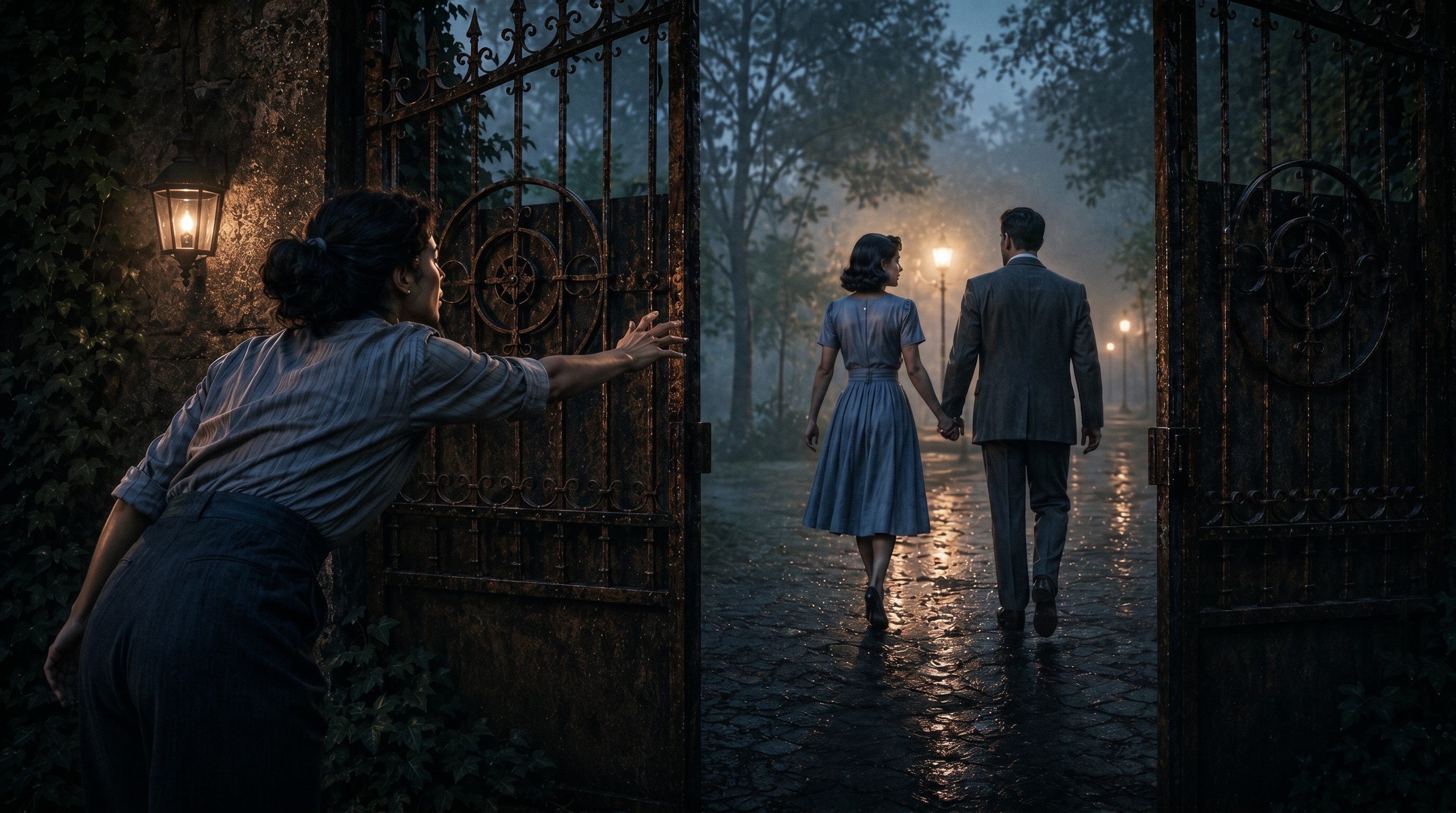
I never saw Elena again as Elena.
I saw her twice after that.
Once outside a church, arm linked through the man’s, wearing a hat with a veil that covered half her face. She stood among women who would have reported her a month earlier and smiled as if she had never learned to fear them.
Another time, years later, in a newspaper photograph from the society page. The image was grainy. Mr. and Mrs. Richard Bell, pictured at a hospital charity luncheon. She was seated beside him at a long table, gloved hands folded neatly in her lap.
The caption called her gracious. Beloved. Devoted.
All the words they give women after they remove the dangerous parts.
I cut the photograph out. I kept it in a drawer for twenty-three years. I do not know why.
That is a lie.
I know exactly why.
Proof matters when everyone else calls disappearance healing.
After Elena left, I stayed in Saint Germaine. People have always found that strange when I tell it, though I rarely do. They think survival means leaving the haunted place. They think freedom means distance.
But distance is expensive, and women like me did not always have the luxury of symbolic gestures.
I paid rent. I went to work. I came home.
I aged.
The building aged around me. Or perhaps it did not age at all. Perhaps it simply got better at pretending to.
The breathing in the floors continued. Not every night. Not loudly.
Just enough to notice.
Sometimes a new tenant would come downstairs pale and sleepless, asking if anyone else felt the boards move beneath their bed.
Sometimes a man would stand too long in front of the lobby mirror, touching his face as if checking whether it still belonged to him.
Sometimes a door would remain slightly open no matter how firmly it had been closed.
I learned which questions to answer. I learned which ones not to.
That is not the same thing as kindness. But it is not always cruelty either.
You live long enough near impossible things, and morality becomes less like a law and more like a draft under a door.
Present. Cold. Difficult to seal.
I should tell you I resisted it.
I should tell you I spent my life warning people.
Sometimes I did. Sometimes.
A young man once asked me if the floor breathed. I told him what the room had been before.
That was warning enough, I thought.
Another asked me if his hands had moved without permission. I told him some things in this building had always listened.
That was almost the truth.
But there were other times.
Times I saw the change begin in someone and did not interrupt it. Times I recognized the stillness. The improved posture. The better sleep. The way grief left their faces as if rinsed out by clean water.
Times I watched a person become calmer, healthier, easier for the world to tolerate.
And I remembered Elena in the rain. I remembered Frances in her white gloves. I remembered how peace looked from a distance. I remembered how badly I had wanted, once, for something to make life stop hurting.
That is the part no one wants to admit about horror.
Sometimes the door is not forced open. Sometimes someone unlatches it. Not because they worship what waits outside.
Because they are tired. Because they are lonely. Because the world has made a shape so narrow that anything offering relief can feel like mercy.
Even if it is only being “better.”
Even if it is only erasure wearing a clean dress.
Years passed. Decades. The city changed its words.
Deviant became sick.
Sick became different.
Different became lifestyle.
Lifestyle became identity.
Identity became something men on television argued about while pretending they were discussing morality instead of power.
The punishments changed clothes too.
Less often wagons outside bars. More often paperwork. Policy. Headlines. Smiles that said concern and meant control.
Every generation thinks it invented cruelty because it found new language for it.
But Saint Germaine knew better.
So did I.
Something kept breathing beneath all of it.
Patient.
Present.
Learning what each era rewarded.
Elena and I could have lived openly then, as so many did now in the Saint Germaine and in the neighborhood around us.
That is the cruelty of growing old.
Seeing your love had come too early. Seeing what your life could have been. Seeing what the times you were born into took from you.
Elena.
The night I finally understood what I had become, there was a girl crying on the second-floor stairs.
She was young. Too young to be as tired as she looked. Mascara under her eyes. Suitcase beside her. One heel broken. A red mark blooming along her wrist where someone had grabbed too hard.
I found her sitting under the emergency light with her arms wrapped around herself.
“My mother says I can come home,” she said.
I sat beside her.
“That’s good.”
“She says I have to come alone.”
Ah. There it was. The old bargain. Safety, priced at the cost of the self. The girl wiped her nose with the back of her hand.
“She says I can still have a normal life.”
The floor beneath us rose. Just slightly. The girl didn’t notice.
I did.
For a moment, I was twenty-seven again, standing in rain beyond the iron gate while the woman I loved smiled with someone else’s peace on her face.
A normal life.
How many people had been fed into that phrase? How many came out polished? How many came out empty?
The girl looked at me.
“What should I do?”
There was a right answer. Leave. Run. Do not bargain with anything that wants to make you easier to love. Do not mistake peace for freedom.
Do not let anything take your ache if your ache is the last proof you belonged to yourself.
That was the answer I should have given.
Instead, I looked down the hallway. One apartment door stood slightly open. Just enough. Warm air drifted through the gap.
The building waited.
Not hungrily. Not maliciously.
That would have been easier.
It waited the way soil waits for seed. The way lungs wait for breath. The way a body waits to know what shape it has been asked to become.
I placed my hand on the floor beside me. The tile was warm. Warmer than it should have been.
“Some things can make life easier,” I said.
The girl looked at me through tears. I heard myself continue.
“But easier is not always the same as yours.”
That was the closest I came to saving her. Maybe it was enough. Maybe not.
She picked up her suitcase and stood. For a moment, she looked toward the open door. Then toward the stairs. Then back at me.
“What happened to you, Mrs. Alvarez?” she asked.
I smiled. Not kindly. Not cruelly either. Honestly, perhaps.
“I survived.”
She left by the stairs. The door at the end of the hall remained slightly open. After she was gone, I sat there a long time. The building breathed beneath my palm.
Up.
Down.
Patient.
I became Mrs. Alvarez because eventually that was what everyone called me. Not at first. At first, I corrected people.
Miss Alvarez. Lydia.
Then I stopped. Mrs. made people comfortable.
It gave them a story. A husband dead or absent. A proper life once lived. A woman alone through tragedy instead of by design.
You would be amazed what people stop asking when they believe a man has already explained you.
So I let them call me Mrs. Alvarez.
I watered plants in the lobby. Collected packages. Taught myself what to say to frightened tenants.
Not too much. Never too much.
People reject explanations offered too early. They need to think they discovered the pattern themselves.
I learned that from the building. Or perhaps the building learned it from me.
I thought of Elena.
Not as she became.
Before.
In our kitchen, sleeves rolled, hair falling loose against her cheek. Soap bubbles on her wrist. Cigarette burning down untouched.
I tried to remember the exact sound of her laugh. For one terrible second, I could not.
Then the floor rose beneath me. A slow, steady pressure. Like something offering to help. Like something saying:
I can take that too.
I pulled my hand away.
“No,” I whispered.
The floor settled. Not offended. Not angry.
Only patient.
That was when I understood the worst thing about it.
It did not need my permission forever.
Only once.
Only in the right moment.
Only when the ache became heavier than the self carrying it.
That was what Elena had given it. Not her body. Not her memory.
Her exhaustion.
And it had returned something the world was willing to call a life.
I should have left Saint Germaine. I know that. I should have packed a suitcase, walked through the lobby, passed the park, ignored the iron gate, and never once looked back.
Instead, I went downstairs.
The lobby plants needed water. The mail had to be sorted.
And somewhere beneath all of it, beneath the floor and the years and the parts of myself I had learned to keep quiet, I still believed the thing breathing below us might return her to me if I stayed close enough.
A new tenant was arriving in 3B the next morning. Deaf, according to the file. I remember standing behind the front desk with his lease in my hand, watching my own fingers trace the name.
The building hummed softly beneath my shoes.
Not sound.
Pressure.
Recognition.
The kind that moves through old floors and old women and old wounds.
I thought about warning him properly. I did. Then I thought of Elena saying:
I don’t have to hurt anymore.
And for one brief, shameful moment, I wondered if that had been true.
Outside, the park was dark. The iron gate waited where it always had, one side slightly open. The front door of Saint Germaine clicked behind me even though no one had entered.
Not fully closed. Never fully closed.
I looked at the lease again. Then down at the floor.
It rose.
Settled.
Breathing.
I should have run from it then. Instead, I stood very still. As I had for decades now.
And wondered what it might give me, if I asked correctly.
Silent Horrors Archive
Signal Cluster: Deployment
Archive Entry: 17
Witness Type: Outsider – Queer / Historical
Signal: Social Optimization
Status: It is learning how to make people acceptable.
Related Archive Entries
Some entries appear in more than one record.
02 — The Second Footstep
03 — The Mirror Is Learning My Face
04 — The Breathing Floor
05 — The Garden That Knew My Name
06 — The Shape Sitting on the Bed
07 — The Voice That Answered First
08 — The Masks That Chose Me
09 — Something Wore Me Correctly
10 — The Memory That Wasn’t Mine
11 — It Gave Me Exactly What I Thought I Wanted
12 — It Wanted Me To See It
13 — The Dog That Stopped Recognizing Me
14 — He Touched Me Like It Was Learning Something
15 — He’s a Good Boy
16 — The Hunger Wasn’t Mine
Some readers start with the stories.
Others start by noticing the pattern.
Some start because something already felt… off.
Most don’t realize which one they are.