
It Hurt Less When I Obeyed
Pain used to warn me something was wrong. Then it started teaching me what to do.

Pain has a memory.
People say bodies remember like it’s metaphor. It isn’t. Bodies keep receipts.
Mine kept the night the police cracked my ribs with batons outside St. Vincent’s.
That was 1989.
We had been chanting ourselves hoarse beneath streetlights, holding cardboard signs gone soft at the corners from rain and sweat and rage. There were too many names on them by then. Too many boys. Too many lovers. Too many men who had vanished from dance floors and hospital rooms and Sunday brunch tables while politicians discovered new ways to look concerned without doing anything useful.
I was twenty-eight and certain anger could keep me alive.
For a while, it did.
Then the line broke. Then the horses came forward. Then someone screamed my name. Then a baton came down across my shoulder hard enough to light the whole right side of my body white.
I remember the pavement. I remember blood in my mouth. I remember someone lying half on top of me, trying to shield me with his own body while shouting, “Don’t move him, don’t move him.”
I don’t remember the ambulance.
I remember waking up in Manuel and Paul’s apartment three days later because hospitals were not always safe places for men like us then. Manuel slept in a chair beside me. Paul changed the sheets when fever soaked through them. Danny crushed pills into applesauce because swallowing hurt. Luis held my hand through the nights when breathing felt like pulling barbed wire through wet cloth.
Luis was the one I loved.
Not officially. Officially, we were friends. Roommates sometimes. Emergency contacts when we trusted forms enough to write the truth down. Men like us used language carefully back then. Lover could become evidence. Partner could become liability. Friend was safer, and sometimes safer was the closest thing we had to forever.
But Luis knew where the pain lived before I did. He could tell by the way I held my coffee whether the ribs were bad that morning. He’d press two fingers beneath my shoulder blade and say, “There. Breathe around it.”
And I would. Because when someone you love tells you to breathe, the body tries harder.
Found family is a phrase people use now because it sounds soft.
Ours was not soft. Ours was triage.
They got me through it.
Then, one by one, the world took them.
Not all at once. That would have been theatrical. The world was crueler than that. It spaced them out. A funeral here. A hospital visit there. A phone call at three in the morning. A memorial brunch where no one knew what to do with all the empty chairs.
By the time I turned sixty-three, Luis had been gone longer than I had ever gotten to keep him.
So had Manuel. Paul. Danny. Half the men who learned how to nurse one another before the world decided we were worth medicine.
The pain was the only one from those years that still visited daily.
That was the ugly little loyalty of it.
It stayed.
Right shoulder. Lower ribs. Left hip from where I landed wrong. A line of nerve fire down my leg when the weather changed.
The beautiful boys at the bars called me “sir” now, which is gay for fossil. The apps were worse. On the apps, aging happens in public and nobody has the decency to pretend otherwise.
So I stopped looking.
I still worked, though. Of course I did. Community center twice a week. Meal delivery on Thursdays. Fundraiser calls. Hospital visits when someone newly diagnosed needed an older queer man to sit beside them and say, truthfully, “You are not the first person to be terrified, and you are not alone.”
That was the job now.
Stay useful. Stay stubborn. Stay alive out of spite.
The pain started changing in March. At first, I blamed the rain. Rain always found the old injuries first. It settled into the shoulder, then the ribs, then the hip, each ache waking in order like lights coming on in a building no one lived in anymore.
That morning, I was packing grocery bags at the center when my left knee flared.
Not the usual ache. Sharper. Cleaner. A hot wire threaded behind the kneecap and pulled tight.
I hissed and grabbed the edge of the table.
“You good, Ray?” Marisol asked.
“Old,” I said.
She snorted. “That wasn’t the question.”
“I’m fine.”
I reached for the next bag. The pain sharpened. Not worse exactly. More specific. Like a finger pressing a bruise and waiting for me to understand why.
I stopped.
The pain vanished. Completely. No fading. No easing. Gone.
I stood there with my hand hovering over a paper bag full of canned soup and oranges, waiting for my body to make sense again.
I reached once more. The pain returned immediately. Bright. Precise. Obedient to my movement. I pulled my hand back.
Gone.
“Ray?”
I looked at the bag. Then at the clipboard beside it. That delivery was for Saint Germaine Apartments. I said I was fine again. That was the first lie.
By the next week, the pain had developed opinions. Left knee meant stop. Right shoulder meant turn around. Ribs meant don’t speak. Hip meant continue.
I know how that sounds. I did not believe in messages from the body. I believed in inflammation. Scar tissue. Nerve damage. Weather. Age. The boring little mechanics of survival.
I had spent too many years watching people turn suffering into metaphor.
Pain was not wisdom.
Pain was not prophecy.
Pain was pain.
And mine had already taken enough from me.
But I also know what my body felt like when I ignored it.
The first time I chose the wrong route, my lower back seized so violently I nearly dropped to the sidewalk. Not a spasm. Not cramping. Something deeper and wetter, like a hand had reached into the meat beside my spine and twisted.
I turned left instead of right.
The pain released. Not gradually. Released. Like a leash going slack.
I stood under a streetlamp with a bag of groceries in one hand and one of those stupid reusable tote bags over my shoulder, breathing hard, sweat cooling under my shirt.
“Absolutely not,” I said aloud.
My ribs tightened. One by one. Not pressure. Fingers. Something hooked beneath the bone and pulled inward until I couldn’t finish the next breath.
I shut my mouth. The ribs loosened. That was when I understood the pain had grammar now. Not language. Not thought. Grammar.
A system of pressure and response. Instruction through hurt. Correction through relief.
I had known men like that once. Doctors. Priests. Cops. Fathers. Lovers too, if we’re being honest and unflattering. Human beings taught the world very early that pain could make a body behave.
Something had been paying attention.
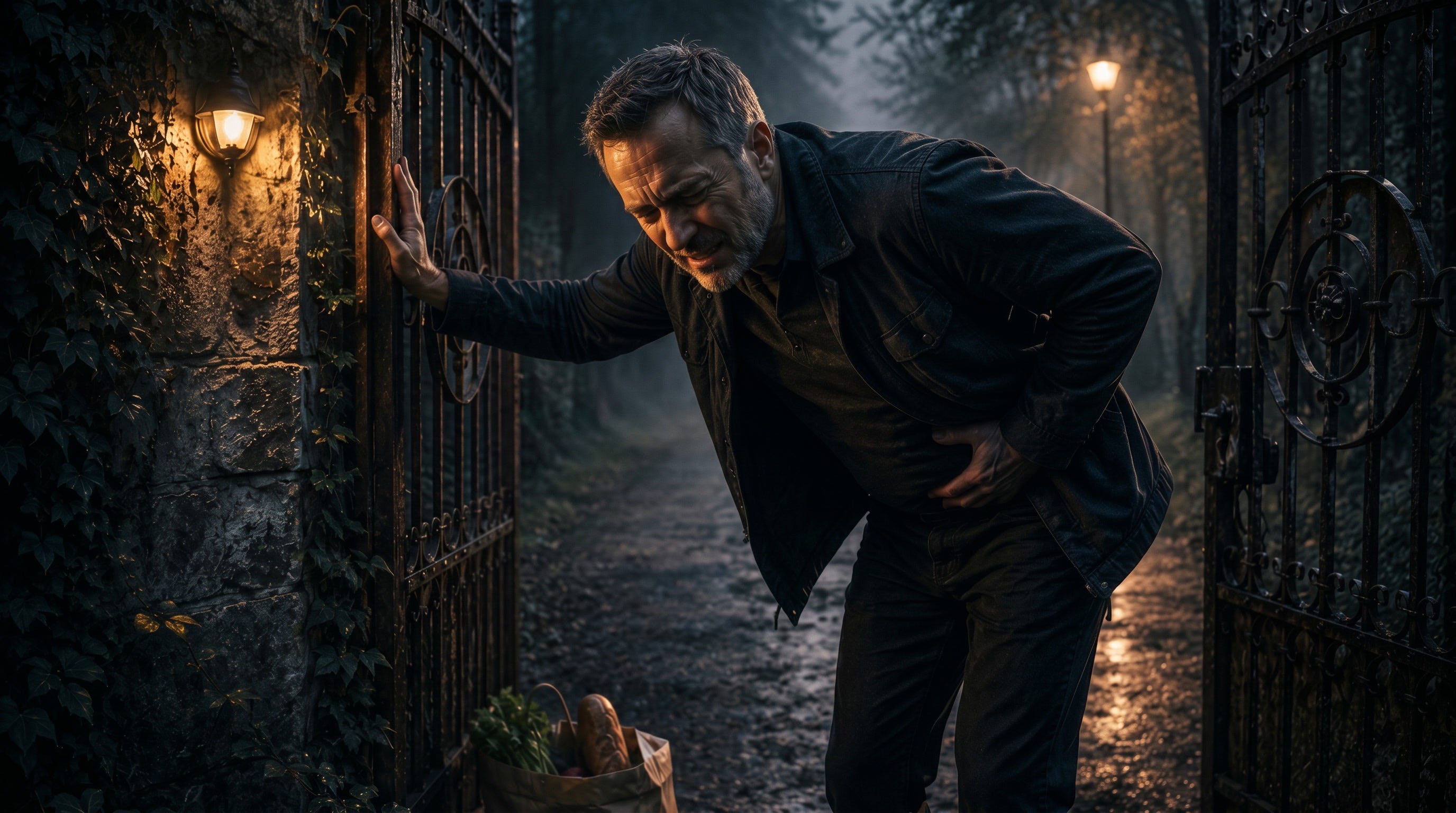
Saint Germaine Apartments sat at the edge of the old park, close enough to the iron gate that you could see its rusted curve through the trees from the front steps.
I hated that gate. Not rationally. Not at first. It was just a gate. Old iron. Stone pillars. One side always slightly open no matter the hour, no matter the weather. The kind of thing city parks collect and forget.
But every time I passed it, my hip stopped hurting.
That was the seduction. Not the gate. The absence. Pain leaving a body is not peace. Not if you have lived with pain long enough.
It is intoxication.
The first time I stood beside the gate and felt nothing hurt, I nearly cried. Not pretty crying. Not one dignified tear down a weathered activist cheek. I mean the ugly, stunned kind. The kind where the body realizes how much it has been surviving and briefly considers forgiving anything that offers relief.
The gate was slightly open. Just enough. The ground beneath my shoes gave one faint tremor. Not loudly.
Just enough to notice.
My knee softened. Go through. Not words. A correction waiting to happen.
I backed away. The pain returned so fast my vision blurred. Shoulder. Hip. Ribs. Knee. All of it.
The old protest injury. The old pavement. The old baton. The old years. Every place the world had ever gotten inside me and stayed.
I made it three steps before I vomited into the grass.
Behind me, the gate moved. Only a little. Like something breathing through the hinge.
Mrs. Alvarez found me in the Saint Germaine lobby two days later, bent halfway over a radiator, trying not to scream.
I had not meant to go there. That was the part I kept returning to afterward. I had meant to go home.
My body had chosen otherwise.
She was watering a fern near the mailboxes, calm as a church hymn. Small woman. White hair pinned neatly. Cardigan buttoned to the throat. The kind of old lady people mistake for harmless because they have never learned that survival can sharpen a person down to a blade.
“You are fighting it,” she said out of nowhere.
“I don’t take orders from pain,” I said. I laughed once. It came out wrong. “Lady, I’ve been fighting since before half this neighborhood was born.”
She looked at me then. Really looked. Her eyes moved over my shoulder, my ribs, the careful way I held myself around old damage.
“No,” she said softly. “That is why it found you.”
The pain tightened behind my kneecap. I gripped the radiator.
“What is this?”
Mrs. Alvarez set the watering can down with great care.
“It’s kinder when you stop arguing with it.”
I stared at her. The hallway lights hummed overhead. Somewhere above us, an old pipe knocked once inside the wall and then went quiet.
“Kinder for who?”
She did not answer. Of course she didn’t. Instead, she lifted one hand and pointed toward the stairs. My hip burned.
“Jonah in apartment 2B needs this,” she said.
I looked down. A grocery bag sat beside my foot. I had not seen her place it there. Inside were protein drinks, compression sleeves, three packs of gauze, a jar of peanut butter, and something wrapped in butcher paper that smelled faintly metallic even through the plastic.
“No.”
My ribs contracted. I bent forward hard, breath leaving me in a thin animal sound.
“No,” I said again, because stubbornness is not always strength. Sometimes it is just the last decorative plate on the wall before the house collapses.
The pain opened. That is the only word for it. Opened.
My left leg filled with heat from hip to ankle. My shoulder socket ground deep, as if cartilage were being chewed between patient teeth. A nerve in my back lit so brightly I saw Manuel’s apartment again for one impossible second: the yellow lamp, the cracked ceiling, Paul asleep on the floor beside the bed because he refused to leave me alone.
Then another memory. Not mine.
A man at a kitchen counter, jaw working around raw meat. Blood sliding down his chin. His body beautiful and wrong under a tank top.
Then hands signing in the dark.
Then a dancer standing too still beneath applause.
Then a dog refusing a doorway.
The pain spread through all of them. No. Not through them. From them. For one second, I felt a city of bodies correcting themselves.
Knees.
Hands.
Teeth.
Backs.
Ribs.
Throats.
A network of small obediences lighting up beneath the streets.
Then the pain arranged me again. My hand closed around the grocery bag. Instant relief. I hated the sound I made. Because it was not fear.
It was gratitude.
Upstairs, the hallway smelled like old plaster and heat and something living behind the walls. Room 2B opened before I knocked. A young man stood there, dark-haired and hollow-eyed, but beautiful in his own way. Deaf, I realized from the way his gaze fixed on my mouth and then my hands. Behind him, the apartment was dim and too warm.
He did not ask who I was. I handed him the bag. My shoulder loosened.
He took it. My ribs released. For one glorious second, nothing hurt.
Nothing. No shoulder. No hip. No back. No old baton buried in the bone. No ghosts in the joints. No weather in the scar tissue. I stood in that hallway with my empty hand still extended and understood, with a terrible tenderness, why people make bargains.
Not because they are weak. Because relief is persuasive.
The young man looked past me. I turned.
At the far end of the hallway, another door was open. Inside, several people sat around a table.
No one spoke. A woman with perfect posture. A dancer I recognized from posters outside the old theater and from some fragment of memory. A handsome man with a swimmer’s body and empty eyes, who I had seen moments ago in my head. A blond woman in workout clothes, her hands folded neatly in her lap.
Mrs. Alvarez moved among them with plates. Not smiling exactly. Serving.
The handsome man lifted something red and wet to his mouth and chewed with mechanical patience. The dancer’s jaw moved at the same rhythm. The woman swallowed without looking down.
No one looked at one another. Then, all at once, every head turned toward me. Recognition passed through the room.
Not theirs. Something below theirs.
My knee pulsed once. Not pain. Instruction. I backed away. The pulse sharpened. I took one step forward. It softened.
That was how it trained me.
Not all at once. Never all at once. Pain is more useful when it teaches gradually. By the end of the month, I knew the neighborhood by nerve.
Left knee for Saint Germaine.
Right shoulder for the park.
Ribs for silence.
Jaw for don’t answer the phone.
Hand for pick it up.
Hip for keep walking.
I still did my community work. That’s the clever part. No one notices an older gay man carrying bags across the city. We’ve always been carrying things.
Groceries. Medications. Names. Ashes. Secrets. The men no one else wanted to touch. The boys who needed somebody to say they’d survive. The grief nobody made room for because the party eventually had to continue.
Now I carry other things too.
Protein drinks. Envelopes. Keys. Gauze. Raw meat wrapped in brown paper. A black notebook with no writing inside until the person opens it. A sealed jar of soil still warm from somewhere underground.
Sometimes Mrs. Alvarez is waiting. Sometimes Jonah. Sometimes no one. Sometimes the door is already open. That is how I know I am early.
The pain is rare now. That should comfort me. It does.
That is the horror of it.
Most mornings I wake before the alarm with my body already turned toward the day’s first route. My shoes by the door. My shoulder loose. My ribs easy. My hip quiet.
On good days, I almost believe I have been healed. My mind still argues.
That is important.
Some mornings I wake furious before I wake hurting. I lie there and list the facts like testimony. This is coercion. This is not healing. This is not Luis telling me to breathe. This is not care.
This is not love.
Then I choose wrong on purpose. Just to test it. Just to prove there is still a self in here capable of disobedience.
The pain comes immediately. Clean. Bright. Exact. A hot line behind the knee. A hook beneath the ribs. A hand closing around the old place where the baton landed.
For half a second, I hear Luis. Not his voice exactly. The memory of it.
There. Breathe around it.
But this pain does not want breath. It wants compliance.
And beneath it all, deeper than injury, deeper than memory, deeper than the men who held me together when the world wanted us dead, something shifts beneath the city.
Patient. Listening. Learning from us what pain makes a body do.
I used to think pain meant something was wrong.
Now I know it means I haven’t obeyed yet.
Silent Horrors Archive
Signal Cluster: Biological Interference
Archive Entry: 18
Witness Type: Outsider – Queer/Resistant
Signal: Pain Conditioning / Behavioral Correction
Status: It is learning what makes you obey.
Related Archive Entries
Some entries appear in more than one record.
02 — The Second Footstep
03 — The Mirror Is Learning My Face
04 — The Breathing Floor
05 — The Garden That Knew My Name
06 — The Shape Sitting on the Bed
07 — The Voice That Answered First
08 — The Masks That Chose Me
09 — Something Wore Me Correctly
10 — The Memory That Wasn’t Mine
11 — It Gave Me Exactly What I Thought I Wanted
12 — It Wanted Me To See It
13 — The Dog That Stopped Recognizing Me
14 — He Touched Me Like It Was Learning Something
15 — He’s a Good Boy
16 — The Hunger Wasn’t Mine
17 — A Normal Life
Some readers start with the stories.
Others start by noticing the pattern.
Some start because something already felt… off.
Most don’t realize which one they are.