

The Dog That Stopped Recognizing Me
He was still doing his job. I just wasn’t the thing he was trained to protect anymore.

The first alert is clean.
It always is.
He lifts his head from the floor and stills, like he’s listening to something I can’t hear. Then he comes to me. Direct, focused, already working.
I set the knife down before he reaches me.
Flat on the counter. Away from the edge.
We’ve practiced this.
“Okay Duke,” I say, moving toward the chair. “Good boy.”
He presses into my legs as I sit, firm and steady, angling his body against mine to keep me upright. Not comfort. Positioning.
If I go down, he needs me clear of anything sharp, anything hard, anything I could hit on the way.
He’s trained for this.
Seizures don’t feel like what people think.
There’s no warning most of the time. No drama.
Just a slip. A drop. One second, you’re there, the next you’re not.
Sometimes lost time. Sometimes waking up on the floor with him already nudging my shoulder and waiting for me to come back.
But he knows before it happens.
He always knows.
That’s what service dogs are for.
Best friends too.
I close my eyes and wait for the shift.
The dimming usually comes first.
A folding inward. Like the room is becoming smaller by degrees.
I count my breaths.
Three.
Five.
Ten.
Nothing.
I open my eyes.
He hasn’t moved.
That’s wrong.
“Hey,” I say, reaching for him. “It’s okay.”
He doesn’t disengage.
His body is rigid against mine. Not scared.
Focused.
Working.
“I’m fine,” I tell him.
He doesn’t believe me.
That’s new.
Then, for one brief, ugly second, something moves behind my eyes.
Not pain.
More like the sensation of something too large trying to fit itself into a space that was never meant to hold it.
It slips away before I can name it.
I exhale.
Headache, I think. Or something close enough to call one.
“False alarm, Duke,” I murmur.
He is still staring at me.
I give the release command.
He obeys.
But only technically.
He backs off. Sits. Watches me with a stillness I have never seen in him before.
Not waiting.
Tracking.
I pick the knife back up.
And for a second, just enough to notice, my hand doesn’t feel like mine.
The second alert happens in the hallway two days later.
No warning. No buildup. Just him, suddenly there, blocking me mid-step, bracing hard against my legs like he’s trying to pin me in place.
“Okay,” I say, automatic now. “Okay, bud, I’ve got it.”
I reach for the wall. Wait for the drop.
Nothing.
No dimming. No absence. No lost edge around the room.
He doesn’t move.
“Hey.”
Still nothing.
I take a step.
He shifts with me. Blocks again.
More force this time.
“Duke. Move.”
He doesn’t.
His eyes are locked on my face. Not checking me. Not searching for symptoms.
Watching.
That’s new too.
I step around him.
He slams back in front of me hard enough that I stumble.
“Seriously?”
He makes a low sound in his throat. Not a bark. Not even a growl. Something smaller. Strained.
Like he’s trying to tell me something in a language I should already know.
Then the pressure comes again.
A brief tightening behind the eyes.
That same impossible feeling of scale. Like something too large has slipped just behind my thoughts and is trying not to be noticed.
I blink.
It’s gone.
“Okay,” I mutter. “Okay. Jesus.”
I go back to the kitchen.
He follows me so closely his shoulder brushes my calf the entire way.
The misalignment starts small.
Later, if you tell it back to yourself, it seems obvious. But at the time it’s just little things.
Things you can fold into stress, recovery, fatigue, the normal low-grade weirdness of living in a body people have cut open and tried to save.
I’m at the stove the first time I really notice it.
The pan is heating. Something with garlic. My laptop is open on the table behind me, blinking idly through a half-finished work email.
Duke’s lying near the doorway where he can see both me and the front door at the same time, which has become his new preferred position.
I shift my weight.
Pause.
Look down.
My feet are turned out too far.
Heels nearly touching. Knees soft. Spine lifted. Arms relaxed at my sides.
First position.
Not fully. Not perfectly. But close enough that my stomach tightens.
I don’t dance.
I never danced.
Not even badly.
I’m not even sure what first position is.
I stare at my own body for a second too long, then correct it with a little laugh that sounds thin even to me.
“Okay,” I say out loud, because being alone too much makes you talk just to hear the room answer. “That’s weird.”
He is already on his feet.
Watching.
I turn back to the stove.
For one brief second, I feel something sharp and directed move through me.
Not hunger. Not pain.
Want.
Something I can’t name, only feel.
A quick, clean pull toward something already chosen.
It vanishes before it can attach itself to anything.
I grip the counter until the feeling passes.
He’s already there, bracing against my legs with a soft whine.
When I go to turn the burner off, I realize the pan was never actually on.
I only remember turning it on.
After that, I start finding things already open.
The laptop first.
I go to bed with it shut. Wake to find it on the kitchen table, screen glowing faintly in the dark.
The cursor is blinking inside a message field I don’t remember opening.
No text. No recipient.
Just that patient little pulse.
Waiting.
Another time it’s the hall closet.
Then the medicine cabinet.
Then the front door, not open exactly, but not fully closed either. Just a little give in the latch when I pass it, as if it had settled wrong.
As if something had used it gently and not bothered finishing the motion.
Each time, he notices before I do.
He stands between me and whatever has shifted.
Or he nudges my hand away from it.
Or he stares until I follow his line of sight and see what’s wrong.
He has started sleeping less.
I know because I have too.
Not dramatically.
Just enough to notice.
And the strangest part is this:
I haven’t had a seizure in weeks.
I mention it to my doctor during a follow-up, and he smiles in that careful, professional way people do when they want your hope to stay manageable.
“That’s encouraging,” he says.
Encouraging.
The word lingers longer than it should.
Because it doesn’t feel like healing.
Healing is usually messy. Uneven. Human.
This feels cleaner than that.
More exact.
Like something solved a problem in me and did not particularly care whether I understood how.
I didn’t ask it to.
A week later I wake up with my keys in my hand.
No memory of getting them.
No memory of standing up.
No memory of crossing the room barefoot in the dark.
I’m just there.
In the hall.
Facing the front door.
Duke is between me and it, every muscle in his body locked tight.
The apartment is silent.
My own breathing sounds wrong in it. Too shallow. Too careful.
“Okay,” I whisper, though I am no longer sure whether I am reassuring him or myself.
The pressure behind my eyes is immediate now.
A heaviness.
A crowding.
Like the shape of something much larger is trying to press itself through me without breaking anything obvious.
I look down.
My fingers are curled around the keys so hard the metal has dented my palm.
He lets out that same strained sound in his throat.
Then, slowly, he lowers his body and plants himself against the floor.
Blocking the door.
Not moving.
A stupid laugh almost rises in me then.
Because this is my dog, my trained, beautiful, reliable dog, lying across the doorway like some overprotective cartoon.
And then, just beneath that almost-laugh, a thought arrives.
Go.
Not a voice.
Not a command.
Just certainty.
Clean. Directional. Already decided.
I reach for the handle.
He lunges up so fast he hits my wrist with his shoulder and the keys fly from my hand.
They hit the floor hard enough to make us both flinch.
For one second, I nearly stop.
For one second, I almost sit down right there in the hall and call someone and say: something is wrong with me and I do not think it is the old wrong thing.
Then the pressure surges.
The hesitation closes over.
I hear myself say, calmly, “Move, Duke.”
He doesn’t.
I step forward.
He blocks me again.
I step harder.
He bares his teeth.
Not at me.
At the space just ahead of me.
That is what I remember later.
Not that he threatened me.
That he threatened whatever was about to happen.
I push through him.
He lets out one sharp, wounded sound as I open the door.
The hallway beyond is empty.
Warm.
Still.
As if it has been waiting.
The next day I find St. Germaine Apartments open on my laptop.
A directions page.
No memory of looking it up.
I know the building by name, distantly. Everyone in this part of the city does. Old place near the park. Drafty. Weird.
The kind of building people describe as having “character” when what they really mean is that it makes them uneasy in ways they’d rather romanticize.
I close the tab.
Open it again an hour later without realizing it.
Close it again.
By evening I am standing in my kitchen, staring at nothing, already dressed to leave.
He is in front of the door.
Watching me.
I press the heels of my hands to my eyes until little stars burst against the dark.
The pressure is constant now.
Not painful. That would be easier.
This is more like spatial wrongness.
Like there is something behind my eyes too large for the shape of my skull, pressing patiently against bone and thought and identity, waiting for the moment I stop resisting long enough for it to fit.
“I should go,” I say aloud.
The sentence lands in the room as if someone else has already approved it.
He does not bark.
He just comes to me very carefully and places his head against my thigh.
A plea.
That breaks something in me.
Almost.
My hand drops automatically to his head.
For a second I feel the urge to kneel beside him.
To cancel the whole thing. To stay home. To close every door in the apartment and lock them and sit with my back against them until morning.
Then the pressure deepens.
My hand leaves his head.
I reach for my keys.
This time he doesn’t try to stop me immediately.
He waits until I touch the knob.
Then throws his full weight against the door before I can open it.
It works.
For one perfect, brutal second, it works.
I stumble. Swear. Nearly fall backward. My grip slips.
The pressure in my head splits bright and mean and I almost cry from the sheer relief of interruption.
“Stop,” I say, but there is no force in it.
He plants himself harder.
His whole body is shaking now.
Not from fear.
From effort.
From trying.
I look down at him and something terrible blooms in me then.
Not anger.
Something worse.
Distance.
As if he is already too far away to help.
I straighten.
The pressure slides into place.
And with a calm I do not trust, I take his harness in both hands and move him aside.
Not roughly.
That’s what makes it worse.
He doesn’t fight me.
He just stares at me while I open the door.
Like he already knows I am leaving him behind in a way that has nothing to do with the apartment.
Outside, the air feels wrong immediately.
Not colder.
Closer.
The walk to St. Germaine is only fifteen minutes if you cut through the park.
Duke heels beside me because training is stronger than fear… until it isn’t.
But he keeps glancing up at me with quick little checks, as if he is trying to confirm I am still where I am supposed to be.
Halfway there, the pressure behind my eyes sharpens and a memory flashes.
A cursor blinking in a dark room.
Hands typing words someone else would read.
It has been patient. Look at it.
The image vanishes before I can hold it.
I stop walking.
He bumps against my leg immediately.
“Sorry,” I say.
My own voice sounds careful. Borrowed.
We keep moving.
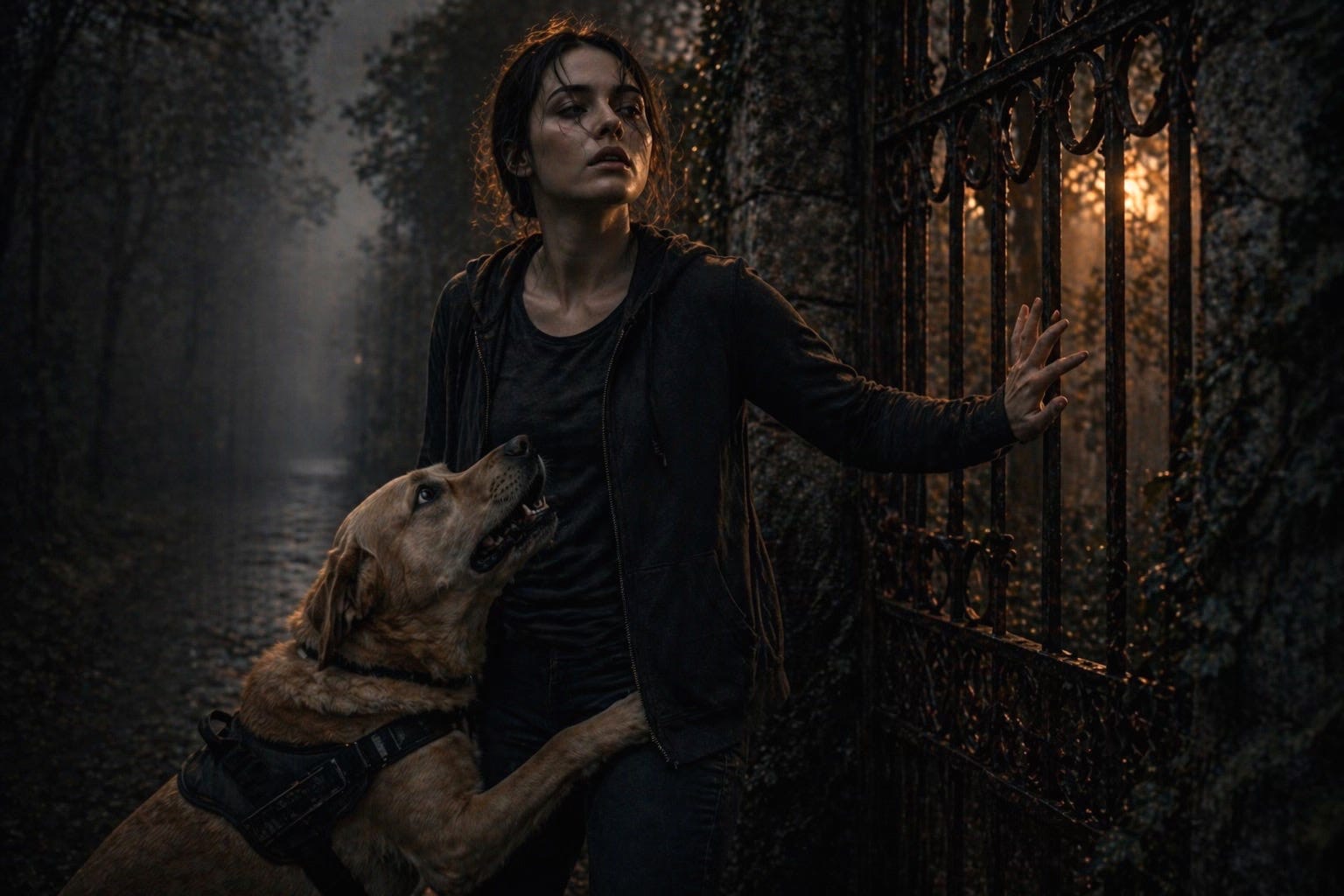
The iron gate appears just before the apartment building does.
Rusted.
Narrow.
One side slightly ajar.
Exactly the way gates in this world never seem to be fully closed.
He notices it before I do. Stops. Goes rigid.
I should keep walking.
Instead, I pause.
Just for a second.
Just long enough to feel the faint vibration beneath my shoes.
Like something far below us had shifted in its sleep.
Not loudly.
Just enough to notice.
My hand lifts.
I do not remember deciding to touch the latch.
But it gives easily beneath my fingers.
Like it is meant to stay that way.
I pull the gate open another inch.
No more than that.
Then I walk on.
I do not look back.
Duke does
St. Germaine is warmer inside than it should be.
Old radiator heat. Dust. Damp plaster. Something medicinal buried very far underneath.
The lobby lights hum faintly.
I do not know where I am going until I am already going there.
Second floor.
Unit 2B.
I do not question how I know that.
That frightens me less than it should.
He begins to resist again on the stairs.
Slowing. Pulling back.
Looking over his shoulder toward the front door as if the smartest version of himself is still standing out there beside the gate, waiting for me to follow him back.
“Come on,” I murmur.
He plants himself harder.
The pressure swells.
For a second I am full of something like hunger.
Not for food. Not for comfort. Not even for relief.
For completion.
For the exact, clean feeling of doing the thing I have already been arranged to do.
I pull him up the rest of the stairs.
By the time I reach the second-floor landing, something is different.
My balance is steady.
Too steady.
No drift. No pull. No sense that the floor might tilt out from under me.
My vision is sharper than it’s been in months.
No aura.
No warning flickers.
No fear of losing time.
My body feels… correct.
Like whatever used to misfire in me has gone quiet.
Like something else is handling it now.
I stop outside 2B.
My hand lifts.
Knocks.
The door opens almost immediately.
He is younger than I expect.
Dark-haired. Tired in that sharpened, hollow way some people look when sleep has become more theory than practice.
Deaf, I realize a second later from the way his eyes go first to my face and then to my hands.
Recognition flashes through me then.
Not mine.
A memory that isn’t a memory.
Hands moving quickly in the dark.
A mouth practicing words before they are spoken.
A gate.
A message.
A room too full of something patient.
The pressure behind my eyes becomes almost unbearable.
He sees it.
Not what it is, maybe. But the effect of it.
His gaze drops to my hands.
So does mine.
I am holding something.
A sealed envelope.
Cream paper. No stamp. No memory of ever seeing it before.
For one stupid second, I nearly laugh.
Because of course.
Of course, I am here to hand over something I do not remember receiving.
He doesn’t move.
Neither do I.
Then my arm extends.
Duke moves.
Fast.
He wedges himself between us, shoulder slamming into my hip, nose pressing hard against my hand.
The envelope crumples slightly under the pressure.
For a second…
just a second…
my arm falters.
My grip loosens.
The pressure behind my eyes spikes, sharp and immediate.
Correcting.
I inhale.
And then my hand steadies.
My arm lifts again.
Smoothly.
Deliberately.
No hesitation. No tremor.
The envelope in my hand, offered toward him with a grace that does not feel like mine.
He hesitates.
My dog lets out a low warning sound beside me.
The man at the door glances down at him, then back at me.
I see the moment he understands that whatever is wrong here is not random.
He takes the envelope.
The pressure in my head eases instantly.
Not gone.
Just… satisfied.
Like something in me has finished what it came here to do.
For one disorienting second, I feel light. Almost euphoric.
Like something in me has clicked into its correct position.
The man opens his mouth as if to speak, then thinks better of it.
His eyes flick once more to my dog.
That look stays with me later.
Not pity.
Recognition.
Like he has seen this before.
Or been seen by it himself.
She is already there.
Not arriving.
Not approaching.
Just… present.
Standing in the hall as if she has been waiting for us to come out.
I somehow know who she is before anyone says a word.
Older woman. Upright. Composed.
A face that would look kind if it did not also look like it has been keeping very old secrets alive through sheer discipline.
She is not looking at me.
She is looking at my dog.
He has gone completely still.
Not alert now.
Not blocking.
Just staring at the floor between us, every line of him pulled inward with a dread so visible it feels indecent to witness.
Mrs. Alvarez’s expression does not change.
“They always try to stop it first,” she says.
Her voice is soft. Matter-of-fact.
I stare at her.
“What?”
She doesn’t answer the question.
Her gaze stays on him.
“They’re not built to hold it.”
Not cruelly.
Not kindly either.
The sentence lands like she is identifying a weather pattern. Something sad but predictable.
“Who are you?” I ask, though what I really mean is: what do you know?
That almost-smile touches her mouth. Small. Private. Familiar in a way I do not like.
“You should go home,” she says.
Not a warning.
A dismissal.
Behind my eyes, the pressure gives one slow, satisfied pulse.
For a moment, I think of saying something else. Pressing. Demanding.
Instead, I turn and leave.
Duke does not look back at her.
After that, everything gets easier.
That is the horror of it.
Not harder.
Easier.
I sleep through the night now.
No waking.
No seizure.
No disorientation.
No checking the clock to see how much time I’ve lost.
I don’t get the headaches anymore.
Not even the small ones.
My hands don’t shake.
My words don’t slip.
I don’t forget what I was doing halfway through doing it.
I don’t need to sit down in the shower anymore.
I don’t need to check where Duke is before I move.
I don’t need him.
And the longer it goes on, the more embarrassing my old dependence on Duke begins to feel.
He knows it before I do.
Or maybe he has known the whole time.
He stops sleeping beside the bed.
Then stops sleeping in the room at all.
He stays in corners now. Doorways. Thresholds.
Watching me.
Never fully relaxed.
Never fully gone.
He won’t make eye contact unless I call his name twice.
Even then, his gaze slips off mine too quickly.
As if whatever is looking back at him is not something he wants to meet for long.
I tell myself he’s stressed.
I tell myself service dogs wash out sometimes.
That maybe something changed in me and he can’t recalibrate.
That maybe he’s aging.
That maybe I’ve leaned on him too long and this is just the slow, humiliating truth of all partnerships: eventually one of you becomes a version of yourself the other can no longer read.
Then I try to remember the last time I actually needed him.
I can’t.
That should feel worse than it does.
Duke alerts again from across the room.
A soft whine. Uncertain.
Like he already knows I’m not going to listen.
I tell myself I’ll look into rehoming him in the morning.
He deserves someone he can actually help.
For the first time, I understand why he’s been wrong lately.
He’s still doing his job.
He’s warning me exactly when the change begins.
I’m just not the thing he was trained to protect anymore.
He doesn’t come closer.
He stays in the doorway.
Watching.
Like he’s waiting for whatever is inside me to finish.
Silent Horrors Archive
Signal Cluster: Biological Interference
Archive Entry: 13
Witness Type: Outsider – Unreliable Body
Signal: Motor Override / Behavioral Correction
Status: It is learning how to move you.
Related Archive Entries
Some entries appear in more than one record.
02 — The Second Footstep
03 — The Mirror Is Learning My Face
04 — The Breathing Floor
05 — The Garden That Knew My Name
06 — The Shape Sitting on the Bed
07 — The Voice That Answered First
08 — The Masks That Chose Me
09 — Something Wore Me Correctly
10 — The Memory That Wasn’t Mine
11 — It Gave Me Exactly What I Thought I Wanted
12 — It Wanted Me To See It
Some readers start with the stories.
Others start by noticing the pattern.
Some start because something already felt… off.
Most don’t realize which one they are.
Lots of threads coming together in this one in interesting ways. One after the other. Almost percussive.
You did a great job setting up the relationship between Duke and the narrator early. The deterioration of their bond later was painful. Poor Duke!